
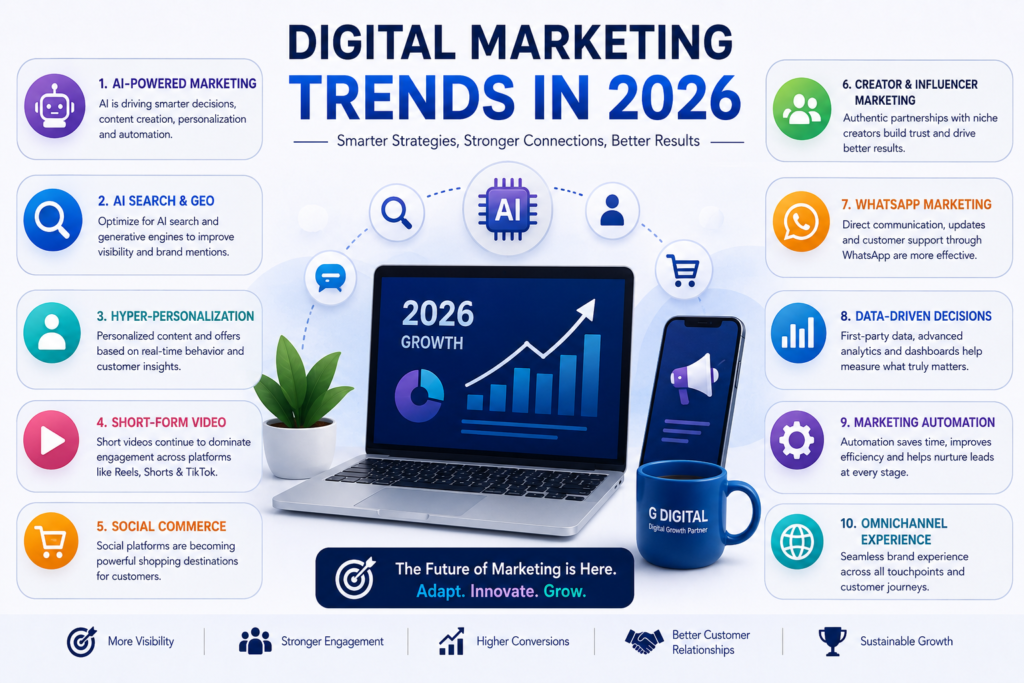
Digital marketing is changing faster than ever. In 2026, businesses are no longer relying on a single platform or traditional marketing strategy to reach customers. Artificial intelligence, AI-powered search, personalization, short-form video, social commerce, creator marketing, automation, and privacy-focused data strategies are transforming how brands attract, engage, and convert audiences.
For businesses, staying updated with the latest digital marketing trends in 2026 is important for remaining competitive. The goal is not to follow every new trend, but to identify the technologies and strategies that can genuinely improve visibility, customer engagement, and business growth.
1. Artificial Intelligence Is Becoming a Marketing Essential
Artificial intelligence is one of the biggest digital marketing trends of 2026. AI is moving beyond simple content generation and becoming part of campaign planning, personalization, analytics, advertising, and customer service.
Marketers are using AI to generate content ideas, analyze customer behavior, create personalized campaigns, automate repetitive tasks, and identify marketing opportunities. Recent industry research shows that AI-enabled personalization and automation are among the leading priorities for marketing teams in 2026.
However, AI should not completely replace human creativity. The strongest marketing strategies combine AI efficiency with human judgment, storytelling, originality, and brand understanding.
2. AI Search and Generative Engine Optimization Are Growing
Search behavior is changing as consumers increasingly use AI-powered search experiences to find information, compare products, and discover businesses.
Traditional SEO remains important, but marketers now also need to think about visibility in AI-generated answers. This has led to growing interest in Generative Engine Optimization (GEO) and Answer Engine Optimization (AEO).
Businesses should create content that clearly answers customer questions, demonstrates expertise, provides original information, and maintains consistent brand information across digital platforms.
The shift is significant: 2026 marketing research shows that updating SEO strategies for changing search experiences is already a major priority for marketers.
3. Personalized Marketing Is Becoming the Standard
Customers increasingly expect brands to understand their interests and provide relevant experiences.
AI is making it easier for businesses to personalize website content, emails, advertisements, product recommendations, and social media experiences. Instead of sending the same message to everyone, marketers can create different experiences based on customer interests, behavior, location, and stage in the buying journey.
HubSpot’s 2026 marketing research identifies AI-powered personalized content as the leading trend among surveyed marketers, with nearly half reporting that they are using or exploring it.
For businesses, personalization can make marketing communication more relevant and improve the customer experience.
4. Short-Form Video Continues to Dominate
Short-form video remains one of the most effective ways to capture attention online.
Instagram Reels, YouTube Shorts, and similar formats allow businesses to communicate their message quickly and creatively. Educational videos, behind-the-scenes content, customer testimonials, product demonstrations, tips, and storytelling can all be used to attract audiences.
However, simply producing more videos is not enough. Authenticity is becoming increasingly important as AI-generated content becomes more common.
Brands that use real people, genuine experiences, useful information, and a recognizable personality can create stronger connections with their audience. Research on India’s 2026 marketing landscape also highlights the continued importance of short-form video while emphasizing the value of human-led content.
5. Social Media Is Becoming a Discovery and Shopping Channel
Social media is no longer only a platform for likes and followers. It has become an important part of the customer journey.
Consumers can discover a brand through a Reel, research it through its profile, communicate through direct messages, and eventually make a purchase without leaving the platform or through a connected website.
According to HubSpot’s 2026 State of Marketing research, social media remains one of the most important marketing channels, with organic social, paid social, and social shopping all playing significant roles.
Businesses should therefore focus on creating platform-specific content rather than simply posting the same content everywhere.
6. Creator and Influencer Marketing Is Shifting Toward Trust
Influencer marketing is evolving from a focus on follower count to a focus on credibility, relevance, and community.
Micro-influencers and niche creators can be particularly valuable because they often have stronger relationships with specific audiences. Instead of choosing an influencer simply because they have a large following, brands should consider whether the creator’s audience matches their target customers.
Authentic product experiences, educational collaborations, testimonials, and creator-led storytelling can help brands build trust.
This trend is especially relevant for local businesses because regional creators can help businesses connect with audiences in specific cities, communities, and languages.
7. Regional and Vernacular Marketing Is Growing in India
India’s diverse language and cultural landscape creates significant opportunities for regional marketing.
Businesses can reach audiences more effectively by creating content in languages that their customers naturally understand and use. Malayalam, Hindi, Tamil, Kannada, Telugu, and other regional-language content can help brands build stronger local connections.
For businesses in Kerala, combining English with Malayalam content can be particularly useful depending on the target audience.
Regional content can include social media posts, videos, blogs, advertisements, WhatsApp communication, and website content.
8. WhatsApp and First-Party Data Are Becoming More Important
Businesses are increasingly looking for direct ways to communicate with customers rather than depending entirely on third-party platforms.
WhatsApp can support customer communication, enquiries, product discovery, follow-ups, and relationship building. At the same time, first-party data—information a business collects directly from its customers—can support more relevant marketing.
Privacy and data protection are also becoming more important. Businesses need to collect and use customer information responsibly and transparently.
For Indian businesses, the combination of WhatsApp communication, customer databases, and permission-based marketing can create valuable long-term relationships.
9. Marketing Automation Is Saving Time
Automation is becoming increasingly important as marketing activities become more complex.
Businesses can automate email sequences, lead follow-ups, customer segmentation, reporting, social media workflows, and other repetitive tasks.
AI is taking automation further by helping systems make decisions based on customer behavior and campaign performance. Research from S&P Global describes AI as increasingly connecting content creation, audience targeting, personalization, and performance optimization across paid, owned, and earned media.
Automation does not mean removing the human element. Instead, it allows marketers to spend more time on strategy, creativity, and customer relationships.
10. Marketing Is Becoming More Omnichannel
Customers rarely interact with a business through only one channel.
A customer might discover a business through Google, watch its Instagram content, visit its website, communicate through WhatsApp, and later make a purchase.
This means businesses need a consistent brand experience across multiple touchpoints.
Deloitte’s 2026 digital marketing research highlights increasing channel fragmentation and recommends connecting channels instead of managing them as isolated marketing activities.
The goal is not to be everywhere. Businesses should identify the channels their target audience actually uses and create a coordinated strategy around those channels.
11. Data and ROI Are Becoming More Important
Marketing decisions are increasingly being based on measurable results.
Businesses want to know whether their investment is generating website traffic, qualified leads, sales, engagement, or customer retention.
In 2026, marketers should monitor meaningful metrics rather than focusing only on vanity metrics such as follower counts or impressions.
Tools such as Google Analytics, Google Search Console, advertising dashboards, CRM platforms, and social media analytics can help businesses understand performance and make better decisions.
What Do These Trends Mean for Small Businesses?
Small businesses do not need to adopt every new technology at once.
Instead, they should choose trends based on their customers and business objectives. A local service business may benefit from local SEO, AI-search optimization, social media, and WhatsApp marketing. An e-commerce business may focus more on short-form video, social commerce, personalization, and paid advertising.
The most effective approach is to start with a clear strategy, test different approaches, measure results, and improve continuously.
Conclusion
The digital marketing trends in 2026 show a clear movement toward AI-powered, personalized, video-first, privacy-conscious, and customer-focused marketing.
AI is improving efficiency, while human creativity remains essential. Search is expanding beyond traditional results, social media is becoming a discovery and commerce channel, and businesses are using data to create more relevant customer experiences.
For businesses in Thrissur, Kerala, and across India, the opportunity is significant. By combining modern technology with authentic communication and a strong understanding of the local audience, businesses can build stronger brands and achieve sustainable digital growth.
The future of digital marketing is not about using every new tool. It is about using the right technology, on the right platform, with the right message, for the right audience.