
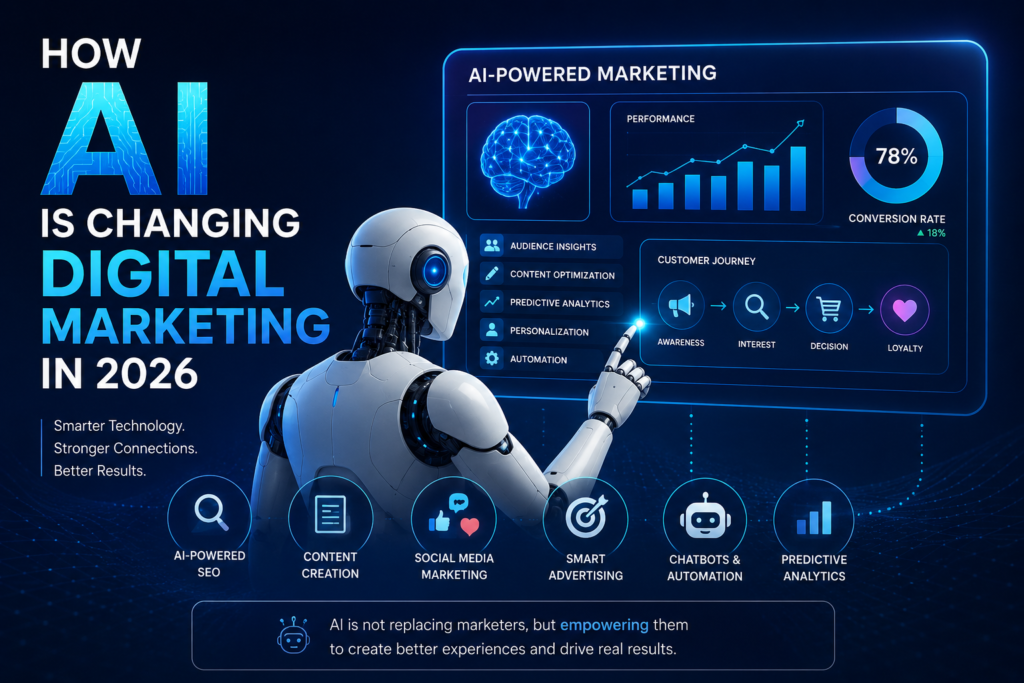
Artificial Intelligence (AI) has become one of the biggest forces transforming digital marketing. In 2026, AI is no longer simply a tool for generating content or automating repetitive tasks. It is becoming an important part of how businesses understand customers, create marketing strategies, improve search visibility, personalize experiences, and measure results.
For businesses of all sizes, understanding how AI is changing digital marketing in 2026 is essential for staying competitive. From AI-powered search and content creation to personalized advertising and predictive analytics, marketers are using intelligent technologies to make faster and more informed decisions.
1. AI Is Transforming Search Engine Optimization
Search Engine Optimization (SEO) is changing rapidly because of AI. Search engines are becoming better at understanding the meaning and intent behind a search query instead of simply matching keywords.
In 2026, businesses need to focus on creating useful, trustworthy, and well-structured content that answers users’ questions. Simply repeating a keyword throughout an article is no longer an effective SEO strategy.
AI tools can help marketers identify search intent, discover content opportunities, analyze competitors, and understand keyword trends. Marketers can also use AI to create content outlines, identify frequently asked questions, and optimize existing website content.
However, AI should support SEO strategy rather than completely replace human expertise. Original insights, real experiences, expertise, and valuable information remain important for building trust with both users and search engines.
2. AI-Powered Search Is Changing How People Find Information
One of the most important developments in digital marketing is the growth of AI-powered search.
People are increasingly asking conversational questions instead of searching with short keyword phrases. AI-powered search experiences can provide direct answers, summaries, recommendations, and links to relevant sources.
This means businesses need to think beyond traditional search rankings. Their goal should also be to create content that AI systems can understand and confidently use as a useful source.
This emerging approach is sometimes referred to as AI Search Optimization or Generative Engine Optimization (GEO). Clear answers, structured information, strong topical authority, and credible sources can help businesses improve their visibility in AI-driven search experiences.
3. AI Is Making Content Marketing Faster
Content creation is another area where AI is making a major difference.
Digital marketers can use AI to brainstorm blog topics, create outlines, generate content ideas, write social media captions, develop email campaigns, and repurpose existing content into different formats.
For example, one detailed blog article can be transformed into social media posts, short video scripts, email content, and infographic ideas with the help of AI.
However, successful content marketing in 2026 is not about publishing large amounts of AI-generated content. Businesses need to combine AI efficiency with human creativity.
Content should reflect the brand’s personality and provide original value. Human editing, fact-checking, storytelling, and strategic thinking are essential for producing content that connects with an audience.
4. Personalized Marketing Is Becoming More Powerful
Customers expect businesses to understand their needs. AI is helping marketers deliver more personalized experiences at scale.
AI can analyze customer behavior, interests, previous interactions, browsing activity, and purchasing patterns. Based on these insights, businesses can provide more relevant content, product recommendations, advertisements, and offers.
For example, an online store can use AI to recommend products based on a customer’s previous activity. An email marketing campaign can also deliver different messages to different customer segments.
Personalization can improve customer engagement because people are more likely to respond to content that is relevant to their interests.
5. AI Is Improving Social Media Marketing
Social media marketing is also being transformed by AI.
Marketers can use AI tools to generate content ideas, analyze audience engagement, identify trends, create captions, schedule content, and understand which types of posts perform best.
AI can help businesses analyze large amounts of social media data much faster than manual analysis. This allows marketers to identify patterns and adjust their strategies more quickly.
AI is also influencing short-form video marketing. Marketers can use AI-assisted tools for script development, video editing, subtitles, voiceovers, and content repurposing.
Even with these technologies, creativity remains important. Audiences still respond to authentic stories, useful information, entertainment, and relatable brand communication.
6. AI Is Changing Digital Advertising
Paid advertising is another area experiencing significant AI-driven changes.
Platforms use machine learning and automation to optimize campaigns based on user behavior and performance data. AI can help marketers identify potential audiences, test creative variations, optimize budgets, and improve campaign performance.
Instead of manually adjusting every part of an advertising campaign, marketers can increasingly use AI-powered systems to automate repetitive optimization tasks.
However, marketers still need to define clear campaign objectives, understand their target audience, create effective messaging, and monitor performance. AI works best when it is guided by a strong marketing strategy.
7. Predictive Analytics Helps Businesses Make Better Decisions
Traditional digital marketing often relies on analyzing what has already happened. AI allows marketers to go further by identifying patterns and predicting possible future outcomes.
Predictive analytics can help businesses understand which customers may be more likely to purchase, which campaigns could perform well, and where marketing opportunities may exist.
For example, a business can analyze previous customer behavior to identify potential high-value customers. Marketing teams can then focus their efforts on audiences with a higher probability of conversion.
This can help businesses use their marketing budgets more efficiently.
8. AI Is Automating Repetitive Marketing Tasks
One of the biggest advantages of AI is automation.
Digital marketers spend significant amounts of time on repetitive tasks such as data analysis, reporting, customer segmentation, content repurposing, email workflows, and basic customer support.
AI-powered automation can reduce the time required for many of these activities. This allows marketers to spend more time on strategy, creativity, customer relationships, and business growth.
Chatbots and AI assistants can also provide customers with quick answers to common questions. When implemented properly, they can improve the customer experience while reducing the workload on marketing and support teams.
9. Human Creativity Still Matters
Although AI is becoming more powerful, it does not eliminate the need for digital marketers.
AI can analyze information and generate content quickly, but human marketers provide strategy, creativity, emotional understanding, brand voice, and critical thinking.
Businesses that depend entirely on automated content may struggle to differentiate themselves. In contrast, businesses that combine AI technology with human expertise can create more meaningful marketing experiences.
The future of digital marketing is therefore not simply AI versus humans. It is about AI and humans working together.
10. What Businesses Should Do in 2026
Businesses should begin adapting their digital marketing strategies to an AI-driven environment.
First, focus on creating high-quality, helpful, original content. Second, optimize your website for both traditional search and emerging AI-powered search experiences. Third, use AI tools to automate repetitive tasks and improve productivity.
Businesses should also invest in first-party customer data, personalization, analytics, and strong brand identity. Most importantly, AI should be treated as a strategic tool rather than a replacement for marketing expertise.
Conclusion
AI is changing digital marketing in 2026 by making marketing more intelligent, personalized, automated, and data-driven. From SEO and content marketing to social media, advertising, customer service, and predictive analytics, AI is influencing almost every stage of the digital marketing journey.
For businesses, adapting to these changes is becoming increasingly important. The companies that succeed will not necessarily be those that use the most AI tools. They will be the businesses that know how to combine AI technology with human creativity, strategy, and authentic customer understanding.
As AI continues to evolve, digital marketers need to keep learning, experimenting, and adapting. By using AI responsibly and strategically, businesses can improve their online visibility, connect with customers more effectively, and build stronger digital marketing strategies for the future.