
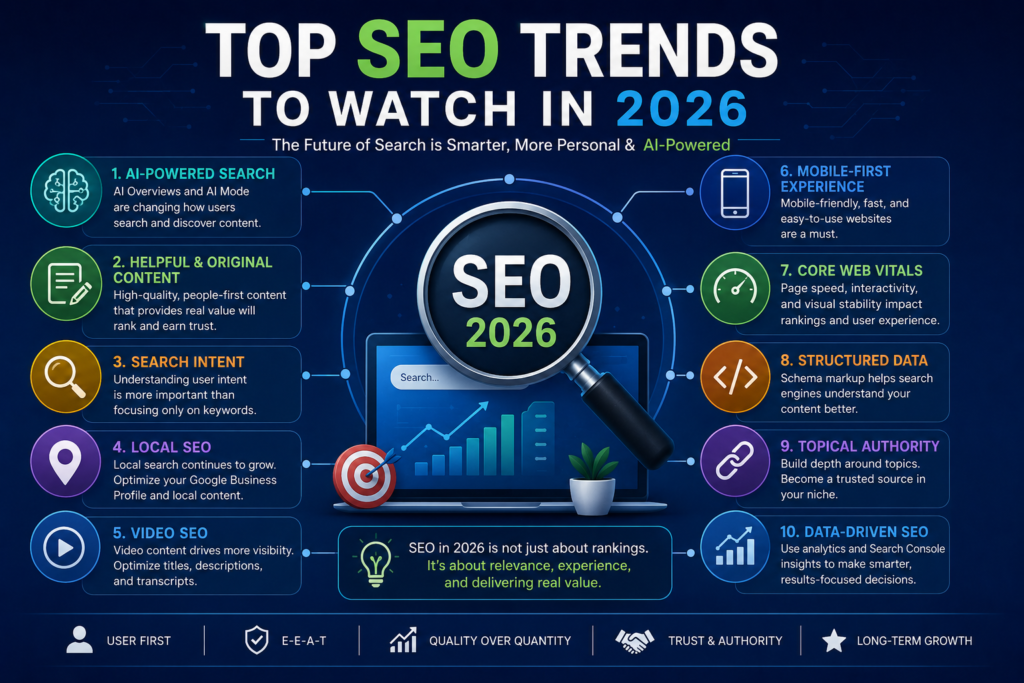
Search Engine Optimization (SEO) continues to evolve as search engines become more intelligent and users change the way they discover information online. In 2026, SEO is no longer only about choosing keywords, building backlinks, and ranking on the first page of Google. Artificial intelligence, conversational search, user experience, video, local search, and content quality are all playing an increasingly important role.
Google has introduced AI-powered search experiences such as AI Overviews and AI Mode, while its official guidance emphasizes that traditional SEO fundamentals remain important for visibility in these new experiences.
For businesses and digital marketers, understanding the top SEO trends in 2026 can help create more effective strategies and maintain long-term online visibility.
1. AI Search Is Changing SEO
One of the biggest SEO trends in 2026 is the growth of AI-powered search.
Instead of simply displaying a list of website links, search engines can now provide AI-generated answers that summarize information from multiple sources. Users can ask longer, more conversational questions and receive more direct responses.
Google’s current guidance explains that its generative AI search features use information from its Search index and continue to rely on core Search ranking and quality systems.
This means businesses should optimize content not only for traditional search results but also for AI-powered search experiences.
The best approach is to create content that is accurate, useful, original, well-structured, and easy for both people and search systems to understand.
2. Generative Engine Optimization Is Gaining Attention
Generative Engine Optimization, often called GEO, focuses on improving a brand’s visibility within AI-generated answers.
As users increasingly use AI-powered platforms to research products, services, and questions, businesses want their websites and brands to become reliable sources of information.
However, there is no magic GEO trick that guarantees inclusion in AI answers. Google’s 2026 guidance specifically recommends focusing on strong SEO fundamentals and valuable content rather than chasing artificial “AEO/GEO hacks.”
Businesses should therefore focus on building topical authority, publishing original information, answering relevant questions, and maintaining a trustworthy online presence.
3. Helpful and Original Content Matters More
Content quality remains one of the most important SEO trends in 2026.
With AI making content creation faster and easier, the internet is becoming increasingly crowded with generic articles. Simply producing hundreds of AI-generated pages is unlikely to create long-term value.
Google recommends creating people-first content that is helpful, reliable, original, and satisfying for visitors.
Successful content should offer something beyond information that can easily be found everywhere else. Original examples, expert opinions, practical experiences, research, case studies, comparisons, and useful insights can make content more valuable.
The goal should not be to create content only for search engines. The goal should be to create content that genuinely helps the audience.
4. AI-Assisted Content Needs Human Expertise
AI tools can help marketers research topics, develop outlines, identify questions, and improve productivity. However, using AI to automatically generate large numbers of pages without adding meaningful value can create SEO risks.
Google’s guidance states that generative AI can be useful for research and structuring original content, but generating many pages without adding value may violate its spam policies on scaled content abuse.
In 2026, a better strategy is to use AI as an assistant rather than treating it as a complete replacement for human writers and marketers.
Human expertise, fact-checking, editing, storytelling, and original perspectives can make AI-assisted content more useful and trustworthy.
5. Search Intent Is More Important Than Keyword Density
Modern SEO is moving away from simply repeating exact-match keywords.
Search engines are becoming better at understanding what users actually want when they search.
For example, someone searching for “best digital marketing services for small businesses” may be looking for recommendations, pricing information, service comparisons, or a provider.
Therefore, marketers need to understand search intent before creating content.
Content should match the user’s purpose—whether that is informational, commercial, navigational, or transactional. Using keywords naturally while thoroughly answering the underlying question can create a better experience and stronger SEO foundation.
6. Local SEO Continues to Be Important
Local SEO remains highly valuable for businesses that serve specific locations.
People frequently search for services using phrases such as “digital marketing specialist near me,” “SEO services in Thrissur,” or “best marketing agency in Kerala.”
Businesses should maintain accurate business information, optimize their Google Business Profile, create location-specific website content, collect genuine customer reviews, and build a strong local online presence.
Google’s 2026 guidance for generative AI search also highlights the importance of providing useful local content alongside other formats such as shopping, images, and video.
For local businesses, combining traditional SEO with local relevance can help attract customers who are actively looking for nearby services.
7. Video SEO Is Becoming More Important
Search is no longer limited to written web pages.
People increasingly discover information through YouTube, Instagram, short-form videos, and other visual platforms. Search engines also provide video results for many types of queries.
Businesses should therefore consider video as part of their SEO strategy.
Creating educational videos, tutorials, demonstrations, FAQs, product videos, and short-form content can increase visibility across different search and discovery platforms.
Video titles, descriptions, transcripts, captions, thumbnails, and relevant keywords can all help users and search systems understand the content.
8. User Experience and Technical SEO Still Matter
Even with the rise of AI search, technical SEO remains important.
Search engines need to crawl, understand, and index websites efficiently. Businesses should pay attention to website speed, mobile usability, site architecture, internal linking, indexing, structured data, broken links, and other technical factors.
A website should also provide a smooth experience for visitors.
A beautifully written article will not perform well as a business asset if the website is slow, difficult to navigate, or difficult to use on mobile devices.
Google continues to emphasize clear technical structure and strong foundational SEO as part of succeeding in both traditional and generative search.
9. Structured Data Helps Search Engines Understand Content
Structured data provides additional information about the content of a webpage and can help search engines understand different elements of a page.
For example, businesses can use appropriate structured data to describe products, organizations, events, articles, and other supported content types.
Google explains that structured data can help it understand webpage content and potentially make pages eligible for richer search appearances.
While structured data is not a shortcut to higher rankings, implementing relevant markup correctly can improve how search engines interpret website information.
10. SEO Measurement Is Expanding Beyond Traditional Rankings
In 2026, marketers need to look beyond traditional keyword rankings.
A website may receive visibility through standard search results, AI Overviews, AI Mode, Discover, video results, local results, and other search experiences.
Google has begun introducing dedicated Search Console reporting for visibility from generative AI features, including AI Overviews and AI Mode, although the new reports are initially rolling out to a subset of websites.
This signals an important change in how SEO performance may be measured. Marketers need to monitor impressions, clicks, conversions, engagement, branded searches, and visibility across multiple search experiences.
How Businesses Can Prepare for SEO in 2026
Businesses do not need to completely abandon traditional SEO strategies. Instead, they should build on strong SEO fundamentals while adapting to new search behaviors.
Focus on creating original and useful content, understand your audience’s search intent, improve your technical website performance, strengthen local SEO where relevant, and use AI tools responsibly.
It is also important to regularly review website performance using reliable first-party data such as Google Search Console. Google recommends evaluating third-party SEO tools carefully and notes that no third-party service can guarantee search performance.
Conclusion
The top SEO trends to watch in 2026 show that search is becoming more intelligent, conversational, visual, and AI-driven. However, the fundamentals of successful SEO have not disappeared.
Businesses still need technically sound websites, useful content, clear information, strong user experiences, and genuine authority.
The biggest change is that SEO now extends beyond traditional blue links. Businesses need to think about how their content can be discovered, understood, trusted, and presented across AI-powered search and other digital platforms.
For digital marketers, 2026 is an opportunity to move beyond outdated SEO tactics and focus on a more complete strategy—one that combines AI, high-quality content, technical SEO, local visibility, user experience, and genuine value.
The businesses that adapt to these changes while keeping the audience at the center of their strategy will be better positioned for sustainable organic growth.